What it is
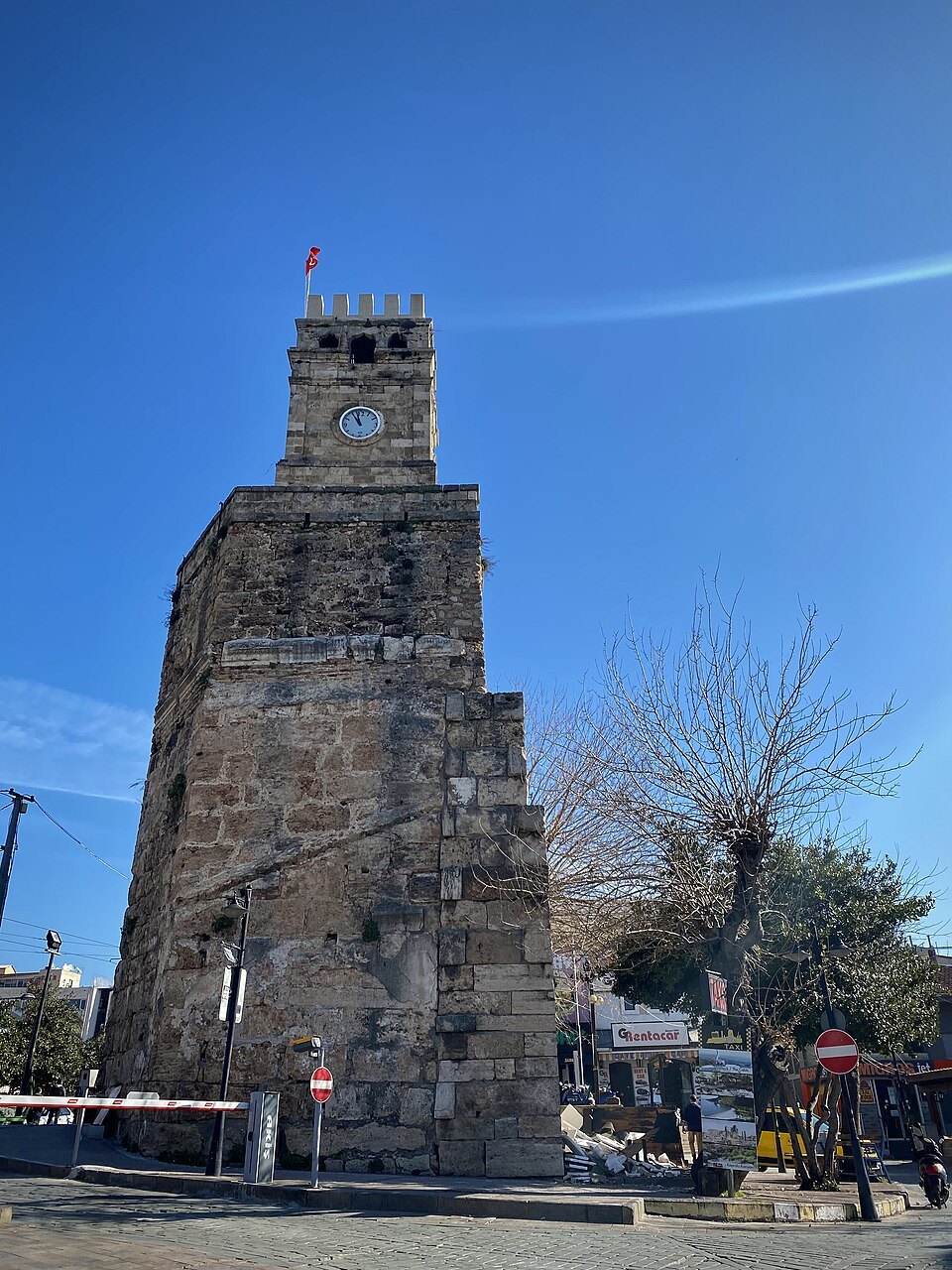
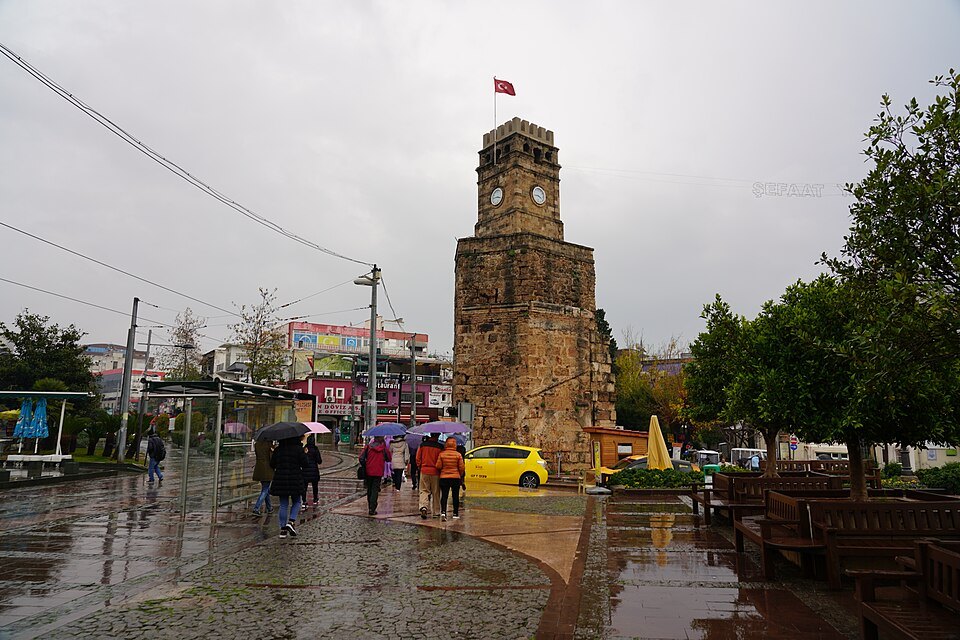
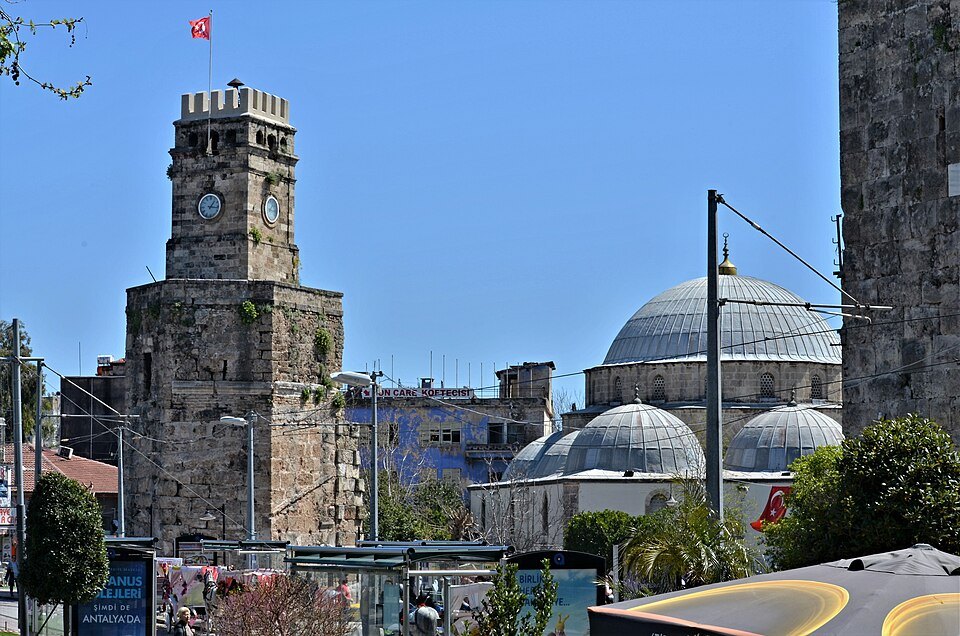
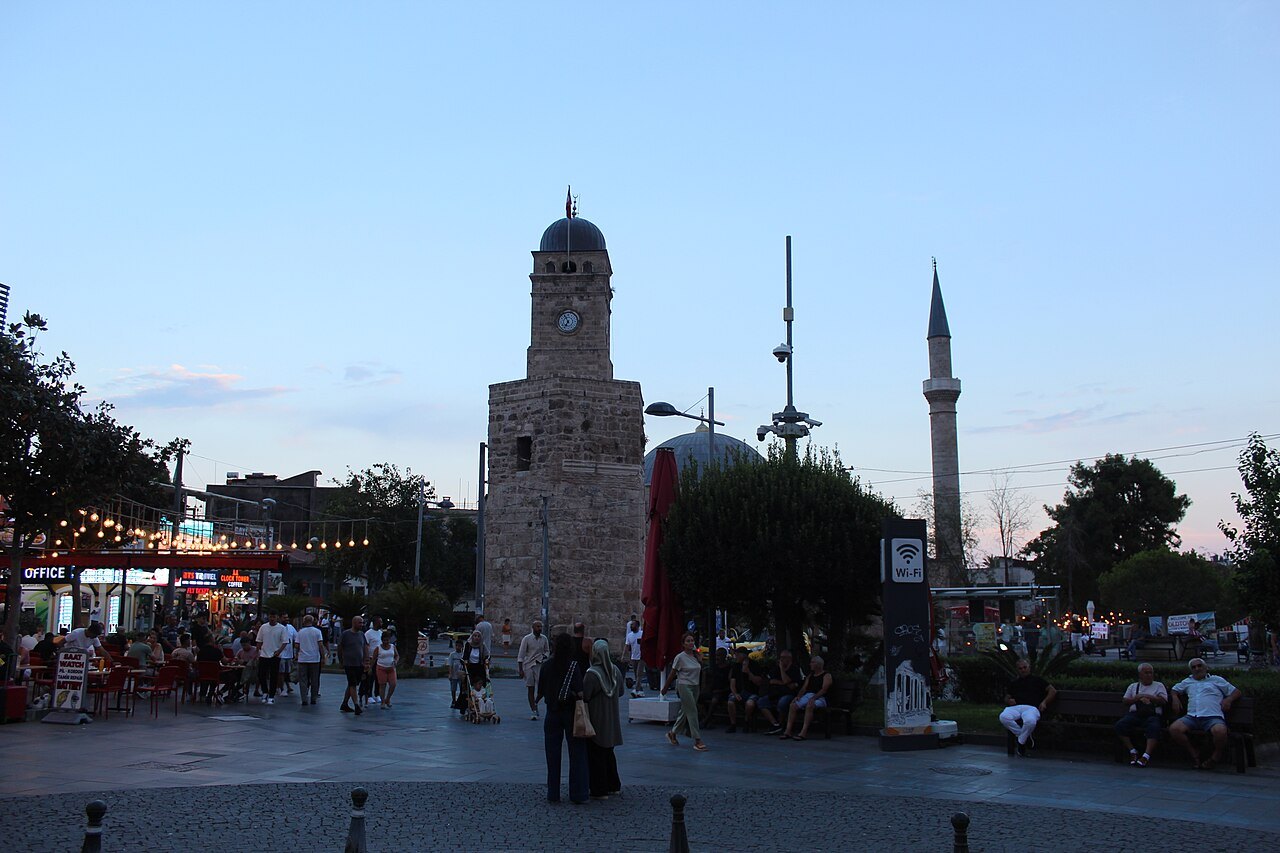
The tower stands at Kalekapısı, the castle gate, where the old town meets the modern shopping streets. The tower sits on the bastion of the old gate; the tower and its clock were added in 1921.
It is the meeting point of the city — the place people say they will be — and the boundary between the two Antalyas: the walled town below and the ordinary Turkish city above.
Around it
The Tekeli Mehmet Paşa mosque is a few steps away, and the fluted minaret is visible from the square.
The gate that was here first
The tower stands on what is left of Kale Kapısı, the castle gate, which was the main landward entrance to the walled town. In the past the roads that reached the city from the east, the west and the north all ended here. The gate is first mentioned by the Seljuk chronicler Ibn Bibi, in connection with the sieges of 1207 and 1216, and it was repaired many times. It went by several names, among them the Market Gate, the Bazaar Gate and the Asitane Gate, and the Ottoman traveler Evliya Çelebi called it the Varoş Gate. By the years of the First World War the gate itself had been pulled down.
The walls it belonged to were old even then. The governorship's account of Kaleiçi says the Romans laid the foundations of the Hellenistic walls and the Seljuks extended and repaired them, reusing many stone blocks with ancient inscriptions, which survived in good condition into the nineteenth century. Today, inside the city, the walls survive mainly in a few pieces: Hıdırlık Tower, Hadrian's Gate and the clock tower.
Along the outer walls there was a tower roughly every fifty paces. The walls still mark the edge of the old town: Kaleiçi is bounded by the sea on the west and by main avenues on the north and east, with the walls running parallel to them, partly still standing. The municipality notes that these sharp boundaries are what protected Kaleiçi from the multistory building of the city center and let its traditional fabric survive. Stand at the tower and you can see the difference: the lanes slope down to the harbor behind you, and the modern city's traffic runs past in front.
A tower from 1921
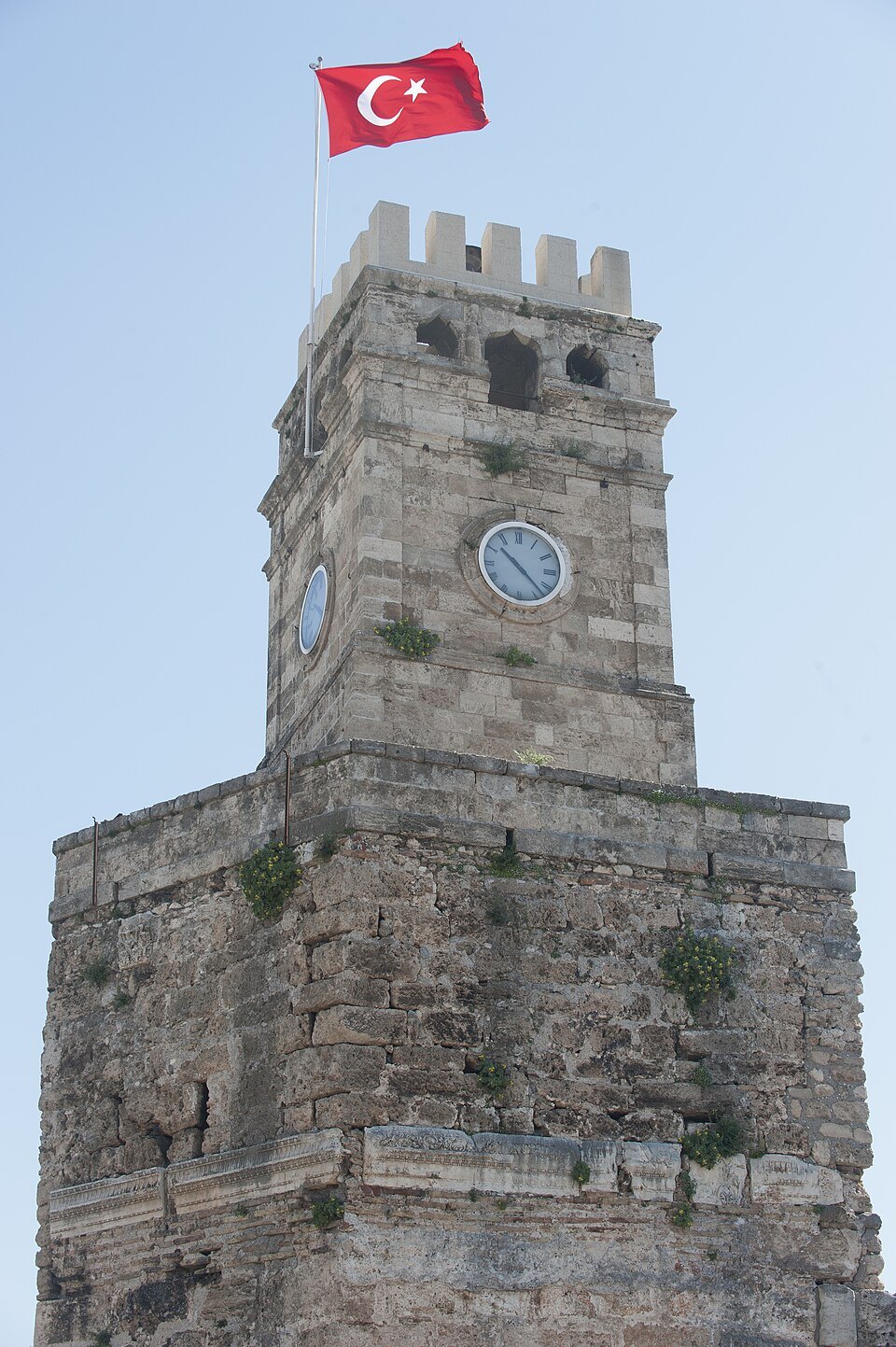
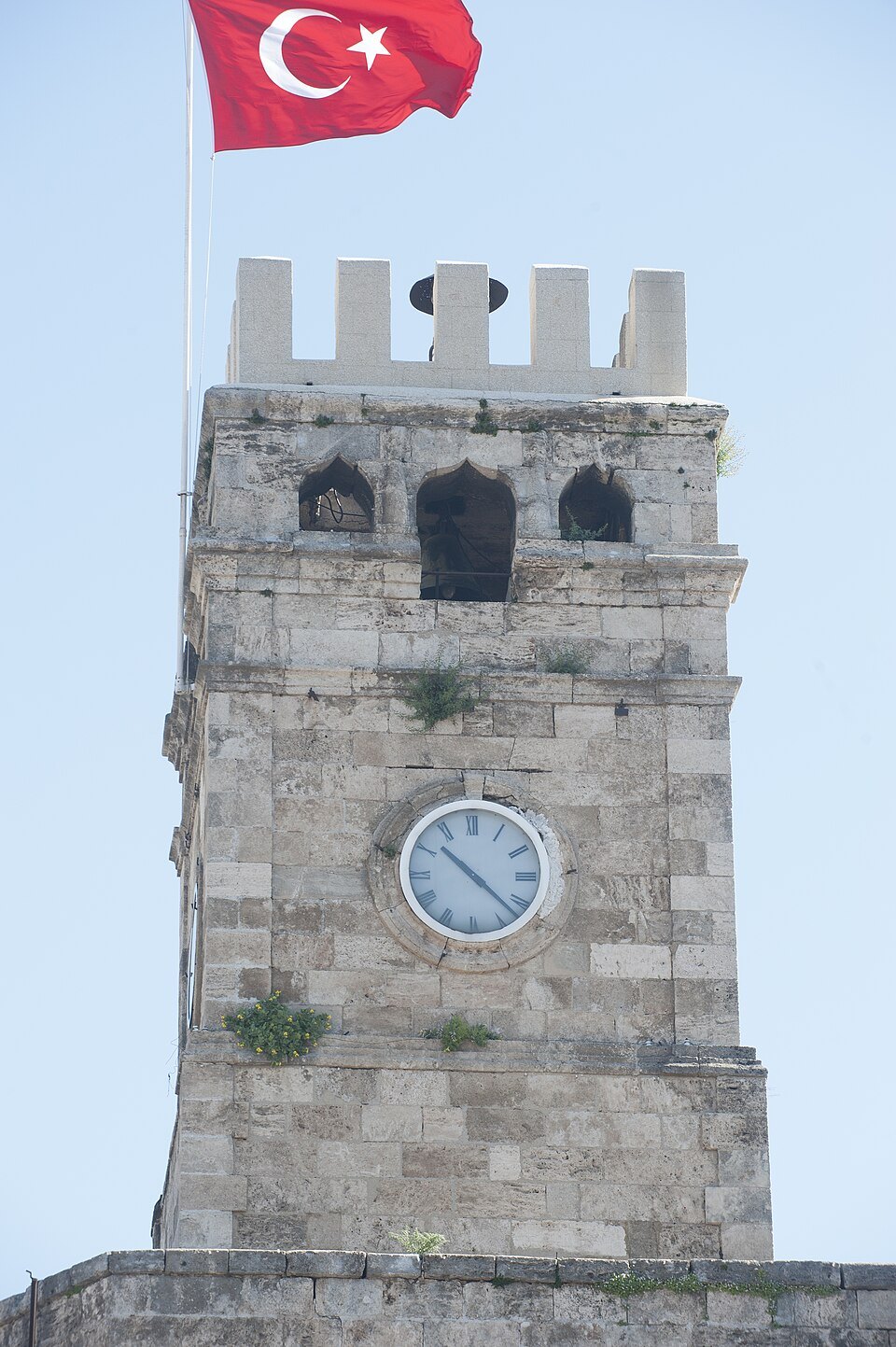
The clock tower itself is younger than it looks. It was built by the Antalya municipality in 1921, at the initiative of people from İzmir who had moved to Antalya after the occupation of their city, and it sits on top of the gate's bastion. It is known to have had a dome on top until 1942; today the top of the tower has a row of five crenellations on each of its four faces. The tower was repaired in 1930 and again in 1967. There is a round clock on each of the four faces, and the dials and works were later replaced with an electronic clock.
The conquest inscription
From the gate, an inner wall once ran down toward the harbor, and it carries one of the oldest texts in the city. Antalya passed to the Seljuks in 1207, slipped out of their control when the local people rose up in 1212, and was taken back by Sultan İzzeddin Keykavus I in 1216. The conquest inscription was written to mark that recapture. It is in Arabic, carved on the rounded undersides of columns set into the inner wall, starting at the Merdivenli Gate and following Uzun Çarşı Street up to Kale Kapısı. It was made up of forty-two pieces, and twenty-six of them are still in place.
That inner wall had a purpose beyond defense. Between the stairway to the harbor and the castle gate, it separated the administrative center and the old Muslim quarters from the rest of the town's population.
The founder in the square
In the square beside the tower is the statue of Attalos II, the king of Pergamon who founded Attaleia in 158 BC. It was made in 2004 for the metropolitan municipality by the sculptor Meretguly Öwezov, who based it on a torso of Attalos in the Pergamon Museum in Berlin and a separate portrait head. The statue stands 2.6 meters high on a square base.
A few steps further on is the Tekeli Mehmet Paşa Mosque, built between 1606 and 1617, so in a few minutes you can pass from a Hellenistic wall to a Seljuk inscription, an Ottoman mosque and a clock put up in 1921.
The Kalekapısı district around the tower also holds the Yivli Minare complex, a group of Seljuk buildings that includes the fluted minaret itself, the Yivli Mosque, the Giyaseddin Keyhüsrev Medrese, a second Seljuk medrese, the Mevlevi lodge and the tombs of Zincirkıran and Nigar Hatun. The minaret, from the thirteenth century, is among the first Islamic buildings in Antalya.
Sources