What it is
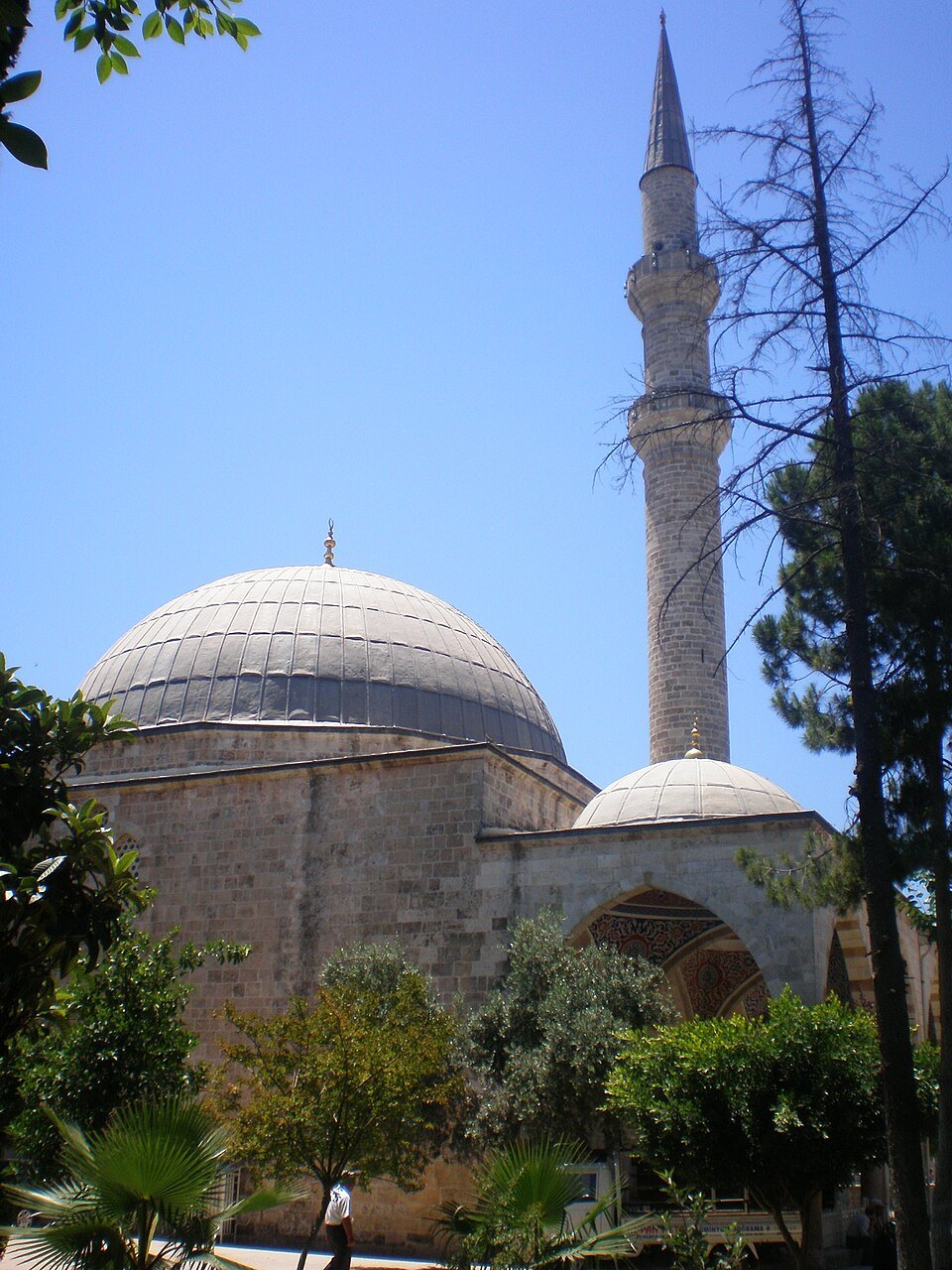
An Ottoman mosque of the sixteenth century, standing outside the old walls in the district that is still called Muratpaşa after it — one of the two central districts of the modern city.
It is a working neighborhood mosque rather than a monument, which is most of its interest: it shows what Ottoman Antalya was doing while Kaleiçi was already old.
Seeing it
⚠️ It is in use. Dress and behavior are expected to match, and prayer times are not visiting times.
Who built it, and what went with it
The mosque was built outside the walls in 1570–71 by Murad Paşa, the governor-general of Karaman, and the inscription over the door gives the date. It was never meant to stand alone. Its endowment deed, dated September 1574 and kept at the General Directorate of Foundations, shows that it also had an imaret, a public kitchen; a medrese founded by Bekir Efendi stood nearby; and Evliya Çelebi mentions a han of the same name that had once existed. The mosque had a major repair in 1960 and is still in daily use as a neighborhood mosque, but the imaret, the medrese and the han are all gone. Exactly which Murad Paşa paid for it has itself been a question for local historians.
The mosque gave its name to everything around it. It stands among some of the oldest neighborhoods of the modern city, Tahılpazarı, Balbey and Muratpaşa, and the Muratpaşa district, founded as a municipality in 1993 and made a district in 2008, takes its name from it. The district now covers Kaleiçi and part of the city center, with 20 kilometers of coast.
The building
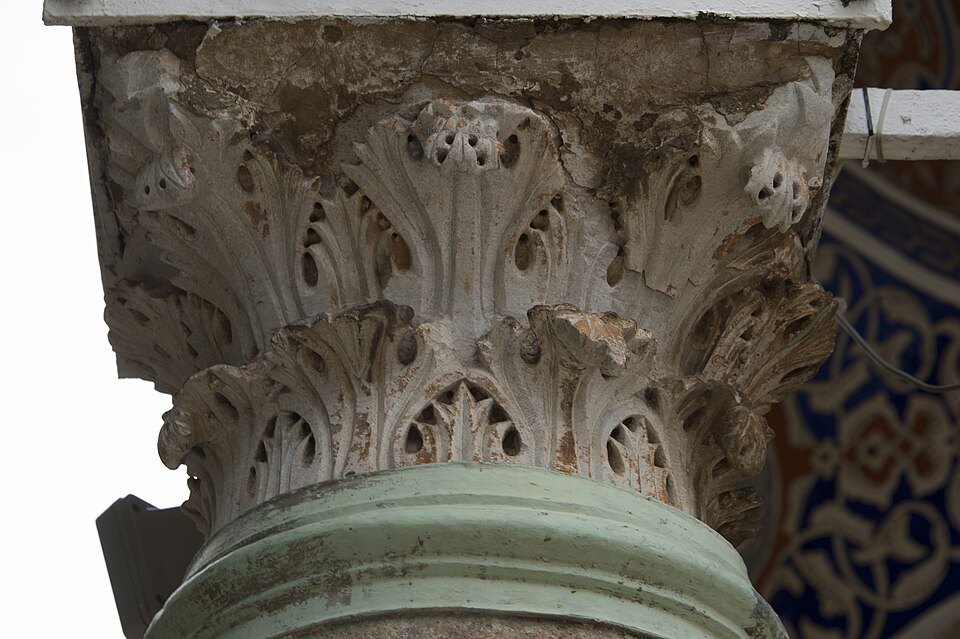
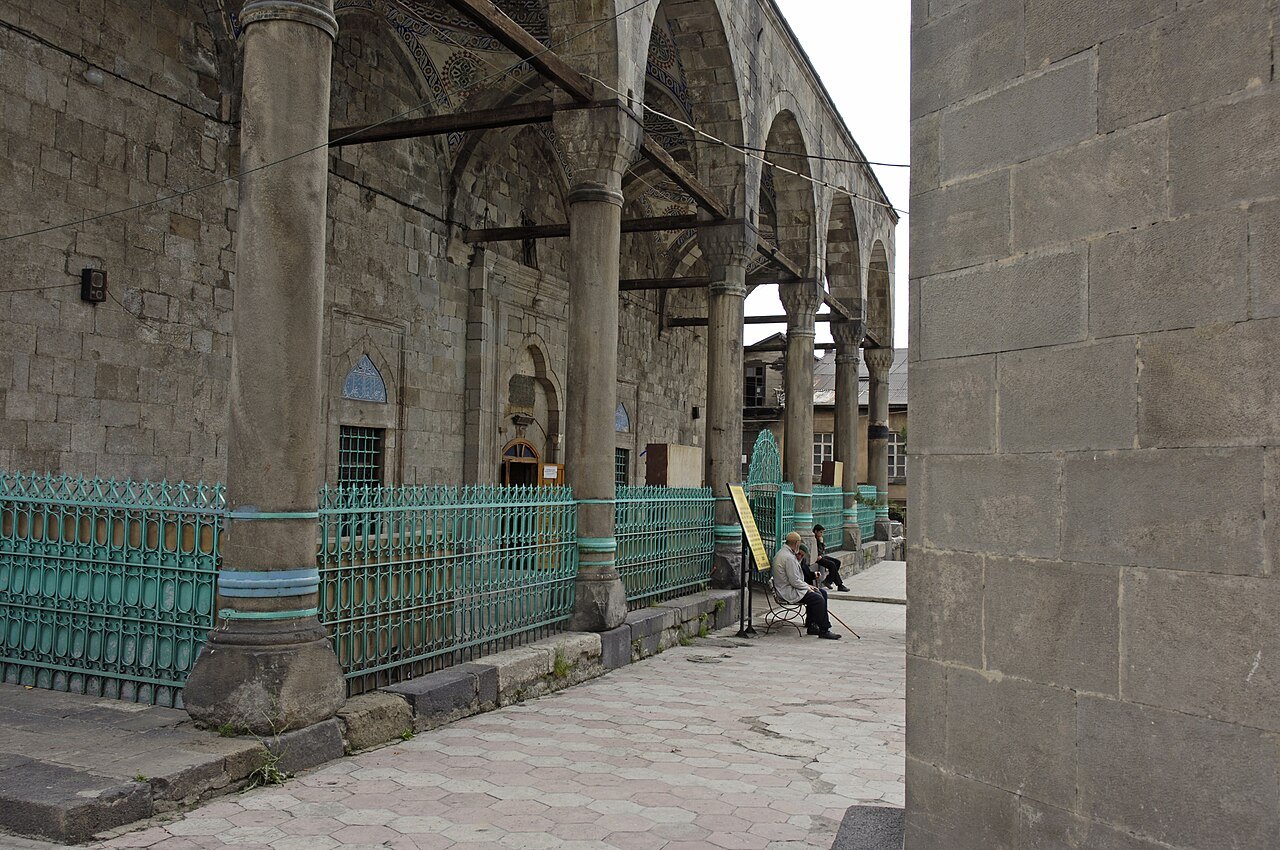
The mosque stands in a broad garden with plane trees a century old and measures about 19 by 18 meters, built of cut stone. Its front porch has three bays with pointed arches in two colors of stone, resting on columns with reused capitals: one with muqarnas, the other three carved with acanthus leaves. Each bay is covered by a small dome. The door, on the axis of the mihrab, has a six-line inscription in sülüs script above it, and small prayer niches on either side, the left one with muqarnas and the right one plain.
The municipality's description adds that the walls are rubble-filled behind their cut-stone facing, and that of the porch columns only the second from the right is marble, carrying a muqarnas capital in the Ottoman style; the rest are stone.
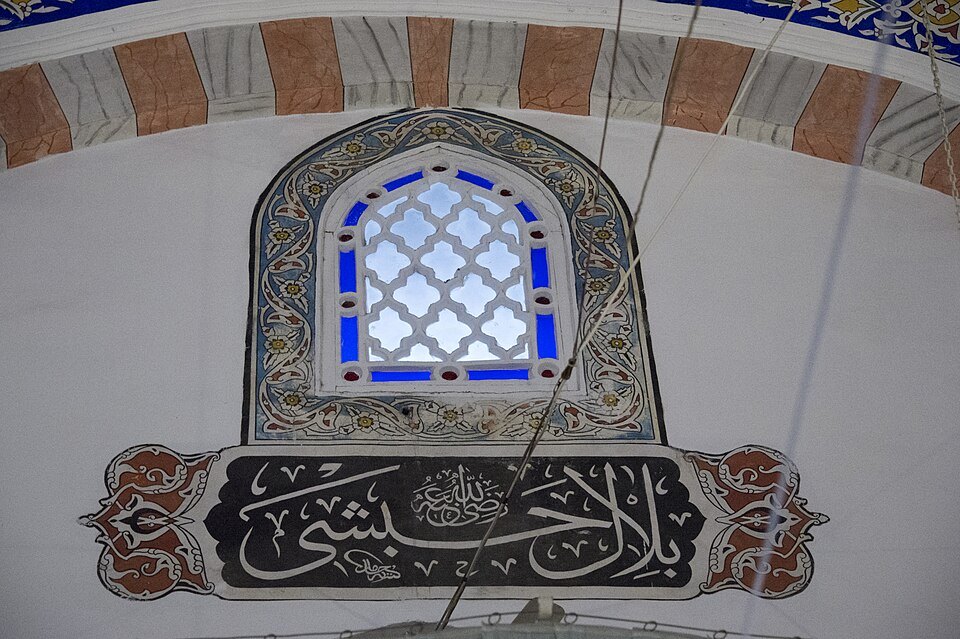
Inside, a single dome covers the prayer hall. From outside it sits on an octagonal drum covered in lead, and inside the transition to it is made with squinches. Two rows of windows light the hall, and a deep, high pointed arch on the north side widens the space for a wooden gallery. The marble mihrab and pulpit are simple.
Painted walls and early tiles
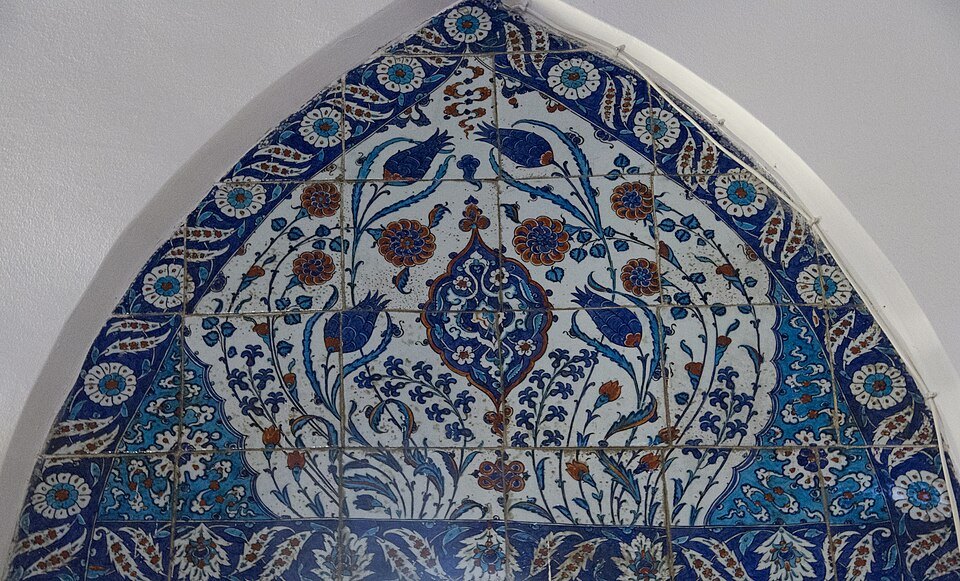
What makes the interior worth a look is its decoration. The porch domes, the inside of the main dome, the squinches and the frames of the upper windows are covered in intricate painted plant designs, renewed in recent repairs, and a band of inscription runs around the top of the walls.
The tympana over the windows on the east, west and south are faced with underglaze tiles. Three designs are each used twice. On the mihrab wall the lettering is dark blue on white with spring branches; on the side walls it is white on dark blue with curling stems; and two panels carry plant designs with no writing at all. The encyclopedia entry notes frankly that the proportions of the designs are off.
Studies of Turkish tile art have singled these panels out; the art historian Filiz Yenişehirlioğlu wrote a paper on the tiles of this mosque alone.
The minaret and the fountain
The minaret, at the north-west corner and reached by a door from the porch, is cylindrical, of cut stone, with two balconies and a lead cap. It is a rebuild of the early twentieth century: the encyclopedia dates it to 1913–1914 and the municipality to 1916, and the old minaret is known to have had a single balcony. North of the mosque is the ablution fountain, an octagonal marble basin under a broad pyramidal lead roof carried on eight marble columns.
A district with the city's whole history
Because the district named after the mosque contains the first settlement of Antalya, its history is the city's history. Attalos II of Pergamon founded a harbor town here and it was called Attaleia after him; Arabic sources call it Antaliye and Turkish ones Adalya, and the name Antalya came into use from the first quarter of the twentieth century. The district today also holds the stages of the Antalya State Theater and the city theater and the Antalya State Opera and Ballet, along with many secondhand bookshops, most of them clustered in the Elmalı and Kışla neighborhoods.
Sources
- Murad Paşa Camii — TDV İslâm Ansiklopedisi (A. V. Çobanoğlu, 2020)
- Kaleiçi — Antalya Büyükşehir Belediyesi
- Muratpaşa — Vikipedi
- Murat Pasha Mosque, Antalya — Wikipedia