What it is
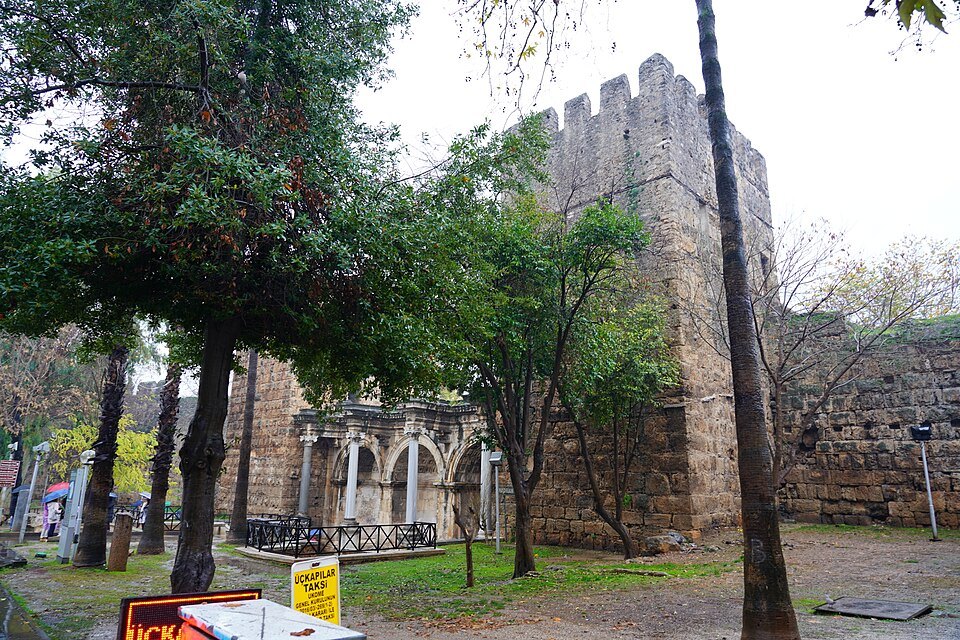
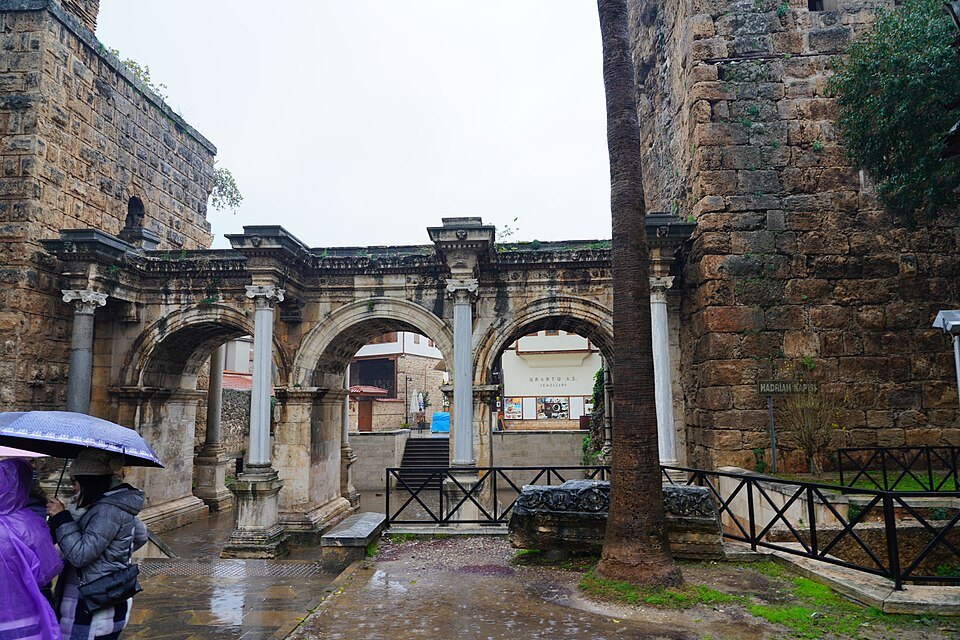
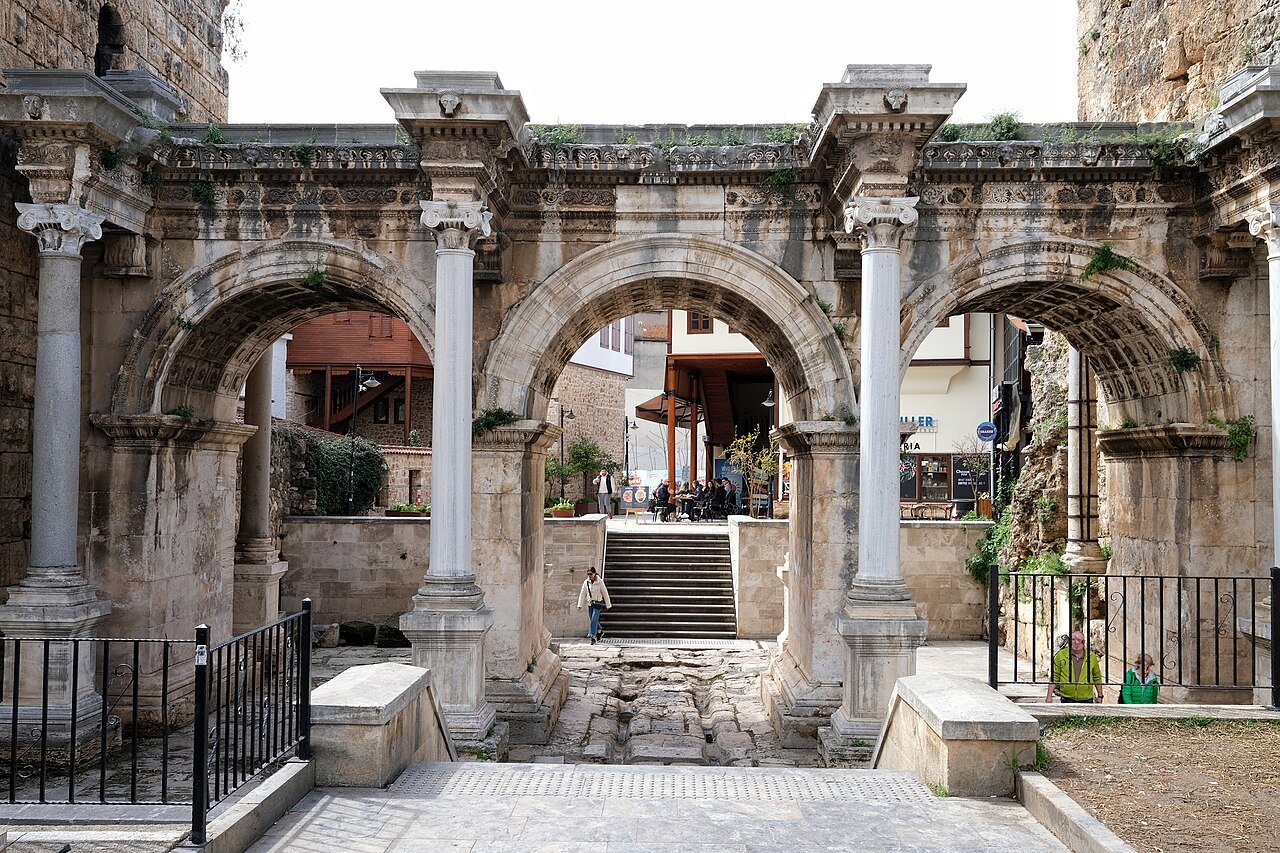
A triple triumphal arch in white marble, set into the old town wall on its landward side. The Turkish name is Hadriyanüs Kapısı; locally it is also Üçkapılar — the three gates.
⭐ It was built for the visit of the emperor Hadrian in AD 130. He came, and the city put up a marble arch. He does not appear to have come back.
What to look at
The marble is not the original road surface. Look down through the grating and you can see the old Roman level well below the modern one, with the rutting of cart wheels still in it — the street has risen several meters since the gate was new.
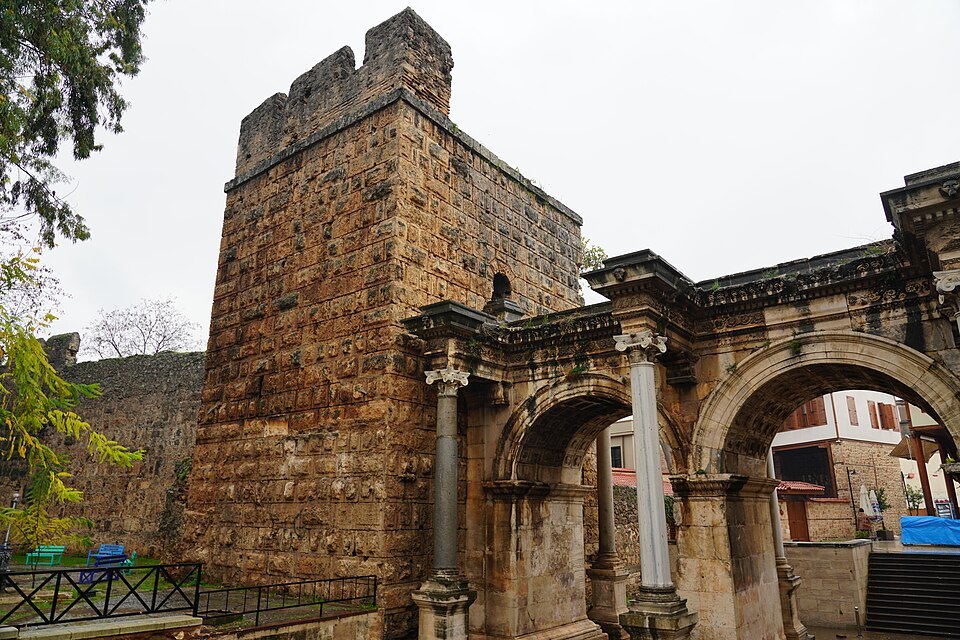
The two towers flanking it are different from each other: the southern one is Roman at the base and Seljuk above, rebuilt long after the arch itself.
A gate built for show
The gate opened onto the roads to Perge, Aspendos and Side and was the most important way in and out of Attaleia. It had nothing to do with defense: it was built purely to impress, in a period of Roman peace. Hadrian traveled to many distant cities during his reign, and they raised monuments in honor of his visits; this one marks his stay in 130 AD. It is often called the most beautiful gate in Pamphylia.
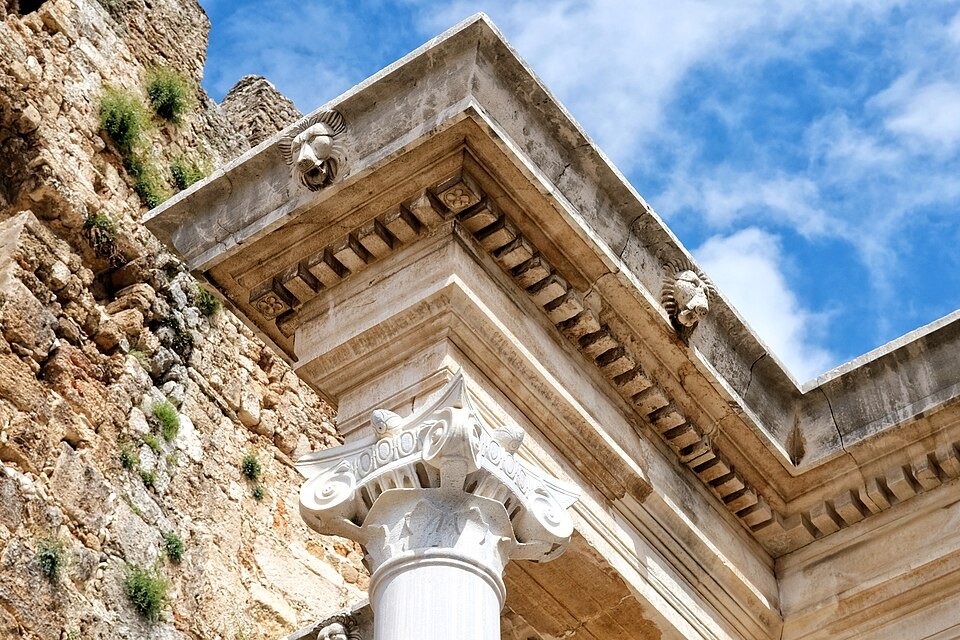
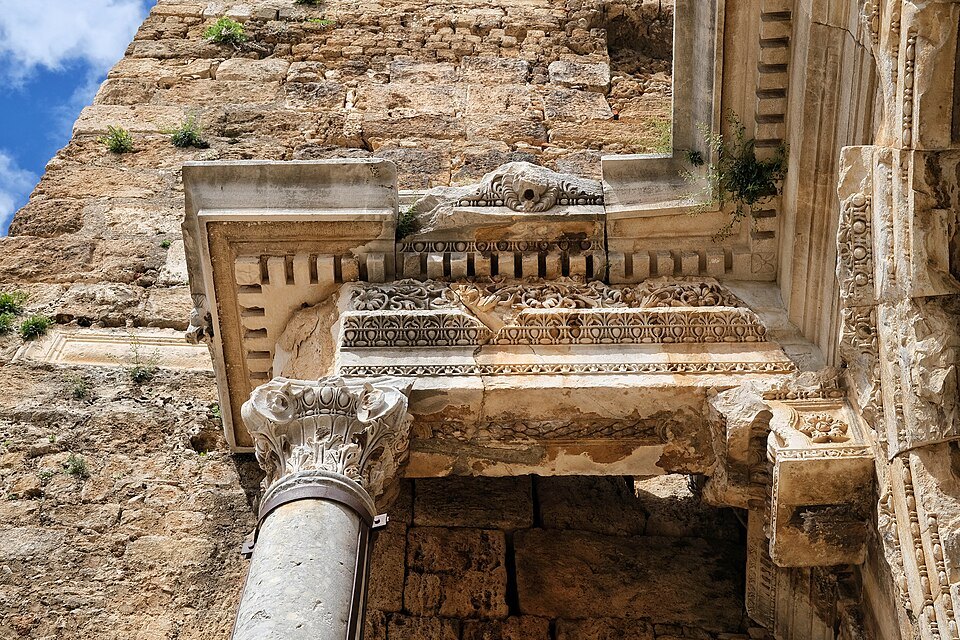
Two richly decorated facades, each with four marble columns, frame three arches rising above four piers, with a tower on each side. Apart from the granite columns, the gate is built entirely of white marble. The vaults of the three passages are carved with flowers and rosettes, and the entablature along the top has a frieze of plant motifs and a cornice with lion heads. When the gate was restored in 1959, the flower reliefs on the side vaults were restored but the central vault was left with plain round reliefs.
The gate is about eight meters high, but marks on top show it once had a second story, probably at least as tall, believed to have carried statues of the emperor and his family. Only four pieces of it survive: three architrave blocks and a spiral column, lying in the small park in front of the gate. Because they sit flat, people use them as benches, and in 2016 one was blackened by a fire someone lit there to keep warm.
Hidden for centuries
During the Byzantine wars the gate was closed for defense and walled up front and back until it vanished from view, which may be why it survived so well. Travelers such as Evliya Çelebi wrote about Antalya without ever mentioning it. The first account came from the British naval officer Francis Beaufort, who commanded HMS Fridericksteen on this coast; the English and Turkish sources give 1817 and 1812 for his visit. In 1872 officials tried to reopen the passage, but a homeowner just inside the wall refused to let his house be demolished.
Of the early scholars, the one who described it in most detail was Count Lanckoroński, who visited in 1882 and published drawings of it in his study of the cities of Pamphylia and Pisidia.
Excavations launched in 1882 by the governor Turhan Paşa pulled down the walls around it and exposed half the gate; the columns fell during the digging and were replaced by pyramid-shaped stone buttresses. The major restoration of 1959 removed those buttresses, put back white marble columns, and stripped the pavement to reveal the original Roman roadway beneath. You can see it today through clear panels set into the floor of the main arch, with deep grooves worn into the stone by the carts that passed in and out of the city. In 2016 the municipality laid out a small sun-shaped garden in front of the gate.
The towers and the letters
The flanking towers were built of large cut stone as part of the Roman city walls. The southern tower, known as the Julia Sancta, is Roman. Under the Seljuk sultan Alaeddin Keykubad I, in the first half of the thirteenth century, the other tower was raised by six meters of smaller stonework to about fifteen meters, and it carries an inscription below its upper windows. Most of the walls that once ran from the towers were demolished in 1937 by the mayor Hüsnü Karakaş, on the grounds that they kept the breeze out of Kaleiçi and made it too hot.
When the gate was uncovered, a dozen bronze letters from an inscription honoring Hadrian were found at its foot. They are now scattered: nine in Vienna, two in Berlin, and others in the British Museum in London and the Ashmolean Museum in Oxford. A local legend holds that the Queen of Sheba passed under this gate on her way to King Solomon, though she lived about a thousand years before Hadrian. In 2021 the approach from Kaleiçi was repaved in stone with Alanya marble railings, opening the gate to pedestrians from both sides.
Sources
- Hadrian's Gate — Wikipedia
- Hadrian Kapısı — Vikipedi (Turkish)
- Kaleiçi — Antalya Büyükşehir Belediyesi